Ten Years of Small Confessions: Reconstructing a Family's Life From Its Smart Home Data
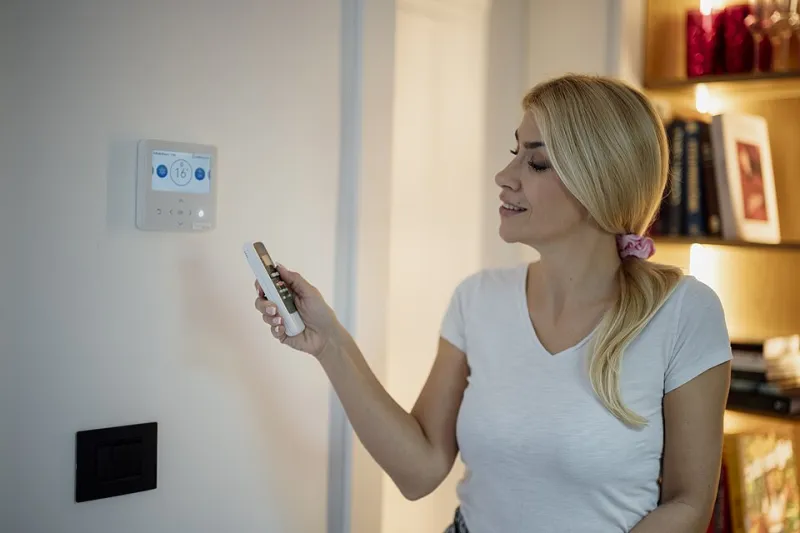
Photo: Shixart1985, CC BY 2.0, via Wikimedia Commons
Consider a hypothetical household in suburban Ohio. In 2014, the Alvarez family installed a learning thermostat. Two years later came a video doorbell, then a voice assistant in the kitchen, smart plugs in the living room, and a connected sleep monitor in the primary bedroom. Each purchase was rational, individually. Together, they assembled something the Alvarez family never consciously agreed to build: a continuous, timestamped portrait of their domestic life.
No single device is particularly revealing. The composite is extraordinary.
What a Decade of Convenience Data Actually Contains
Start with the thermostat. Modern models log occupancy patterns with remarkable fidelity — when the house empties in the morning, when it fills again, which rooms are used and when. Heat set to a constant 78 degrees for two weeks in July? That's a vacation, inferred without a single travel booking. A guest room that suddenly runs warm every night for six months may indicate a relative moved in. A thermostat that stops registering occupancy in the master bedroom while a guest room warms up can sketch the outline of a separation.
The doorbell adds faces and schedules. Package deliveries, visitors, the rhythm of comings and goings — much of it stored in the cloud, some of it shareable with neighbors through app networks, and in documented cases, accessible to law enforcement through voluntary partnerships or warrants.
Voice assistants contribute a different kind of record: the queries themselves. Requests for divorce attorneys, bail bondsmen, oncologists, or late-night podcasts played at 3 a.m. while the rest of the house sleeps. These utterances may be retained, reviewed by human contractors for quality purposes, or produced in response to legal process.
Where the Timeline Resurfaces
The Alvarez family's hypothetical archive matters because behavioral timelines have already appeared in real legal proceedings. In several American criminal cases, prosecutors have sought smart-device records — thermostat logs, voice assistant recordings, fitness data — to establish presence, absence, or state of mind. Defense attorneys have used the same records to establish alibis. The data cuts both ways, but the household rarely controls which way.
Civil litigation follows a similar path. In divorce proceedings, attorneys have requested records showing when a spouse actually returned home. Personal-injury cases have hinged on whether a smart light was ever switched on in a room where an accident occurred.
Insurance is quieter but no less consequential. Data brokers aggregate household-level signals — occupancy patterns, device density, delivery frequency — and sell derived segments to insurers, marketers, and lead generators. A home that appears vacant four nights a week is a different risk profile, and possibly a different premium, than one the data says is always occupied.
None of this requires a breach or a hacker. The exposure is the product working as designed.
A Room-by-Room Audit of the Home You Already Own
You need not smash your devices to reclaim meaningful control. A structured audit, done once and repeated annually, addresses most of the exposure.
The entryway. Open your doorbell app and review retention settings. Delete old clips, disable clip sharing to neighborhood networks, and check whether footage is stored locally or in the cloud. If your provider discloses law-enforcement request policies, read them.
The kitchen and living room. Open your voice assistant's privacy dashboard and listen to a few archived recordings. Most people are startled by what was captured incidentally. Enable auto-deletion of recordings older than 30 or 90 days, and review which third-party skills retain access to your account.
The bedroom. Sleep monitors and smart speakers in intimate spaces deserve the strictest scrutiny. Consider whether the convenience justifies the record. If you keep the device, mute the microphone by default and disable voice-purchase features.
The basement and utility spaces. Smart plugs and water sensors feed occupancy inferences too. Consolidate them under one account with two-factor authentication enabled — a compromised hub is a compromised timeline.
The account layer. Every device above reports to a corporate account. Change passwords that haven't been rotated in years, review connected third-party apps, and download whatever data export the manufacturer offers. That export is, roughly, what a subpoena or a data broker would get.
The Larger Question
The Alvarez family did nothing careless. They bought well-reviewed products and used them as intended. That is precisely the point: the behavioral timeline is not a malfunction of the smart home but one of its outputs. Convenience and record-keeping are the same process viewed from different ends.
Regulators have begun to notice — the FTC has pursued connected-device makers over retention and misuse of recordings — but enforcement moves slowly while adoption moves quickly. Until the law catches up, the audit is the practical answer. Your house is already keeping a diary. The only open question is whether you've ever read it.