Scan, Pay, Compromised: The Quiet Takeover of the American Sticker
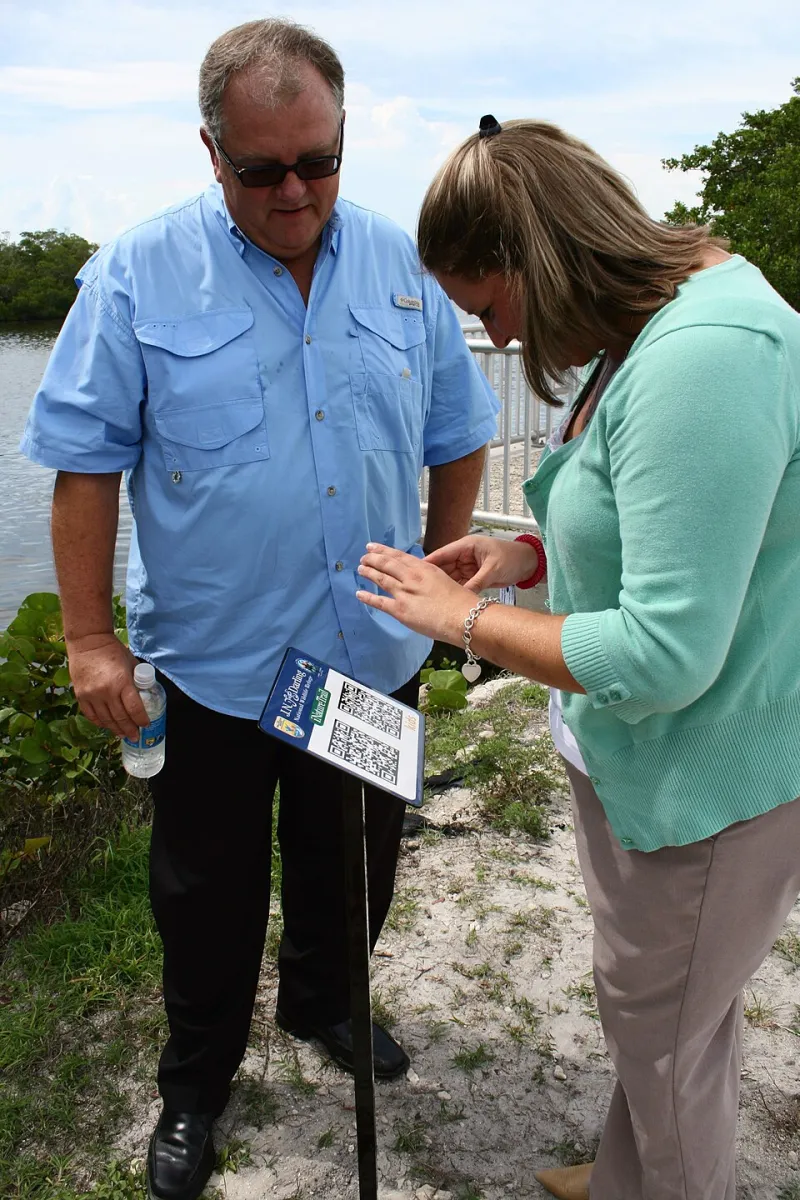
Photo: U.S. Fish and Wildlife Service Headquarters, Public domain, via Wikimedia Commons
There was a time when the act of visiting a website involved a small ritual of attention. You typed an address, letter by letter, and in doing so you read it. A fraudulent domain had to survive the scrutiny of a human being who was, however briefly, watching the words appear on screen.
The QR code ended that ritual. Point, frame, tap. The camera does the reading, and the reader does the trusting. It is precisely this displacement of attention that attackers have learned to exploit, and American cities have become their laboratory.
The Sticker Economy
Security researchers began documenting the phenomenon in earnest around 2022, when police departments in Texas, Kansas City, and several Colorado municipalities reported fraudulent codes affixed to public parking kiosks. The scheme is elegantly simple. A attacker prints a QR code on a sticker that mimics the design language of the original — same color scheme, similar iconography, an official-looking border — and presses it over the legitimate one, or places it just beside it where a distracted driver is likely to aim their phone.
The destination is rarely the payment portal the sticker promises. More often it is a convincing replica: a parking-payment page that asks for a card number, a billing address, a ZIP code. Some harvest credentials for accounts tied to municipal payment systems. Others plant payment-details forms that feed directly into criminal resale networks. The amounts involved are frequently small — a few dollars for a parking session — which is exactly the point. Small charges attract little scrutiny, and by the time a pattern emerges, the sticker has been peeled away and reapplied somewhere else.
The technique, dubbed "quishing" by security professionals, has since spread well beyond curbside meters. Restaurant table tents, flyers taped to utility boxes, brokerage signs on suburban lawns, charity donation posters outside grocery stores — any surface where a QR code signals legitimacy has become a potential mounting point.
Why the Scam Works: The Death of URL Skepticism
Consider what we lost when we stopped typing addresses. A phishers' greatest obstacle has always been the moment of doubt — the slightly wrong domain, the unexpected hyphen, the misspelled brand name. With a QR code, that moment never arrives. The phone resolves the destination silently, and modern camera software opens links with a single tap before the user has registered the URL at all.
There is also a trust transfer at work. A QR code printed on a city-owned meter, laminated onto a restaurant menu, or stapled to a community bulletin board inherits the credibility of its physical surroundings. We extend to the sticker the same confidence we extend to the infrastructure it sits on. Attackers understand this implicitly: the physical world lends its authority to the digital payload.
The pandemic accelerated our conditioning. When restaurants replaced printed menus with table codes virtually overnight, Americans were trained, in the span of a few months, to scan without hesitation. That reflex is now a standing vulnerability.
Reading the Physical World With a Skeptic's Eye
None of this means every code on every surface is hostile. It means the surface itself deserves a glance. A few habits go a long way:
- Look for layers. A sticker placed over an original often betrays itself — peeling edges, a slight color mismatch, a bubble of trapped air, or a code that sits at an odd angle relative to the mounting surface. On parking kiosks, compare the code against any printed instructions or signage nearby.
- Prefer embedded payments over stickers. Many municipal systems now let you pay through a dedicated app or a code printed permanently into the kiosk itself. A code printed on a removable sticker is inherently more suspect than one etched into the machine.
- Read the URL before you tap. Most phone cameras display the destination link before opening it. Take the two seconds to actually look. A payment page for a city parking system should resolve to a government or official vendor domain — not a string of random characters or a lookalike domain with an unusual top-level extension.
- Be wary of codes that ask for payment details immediately. Legitimate parking systems typically accept payment through recognized channels and rarely demand full card numbers on an unfamiliar mobile page.
- Trust context. A QR code on a laminated, professionally printed menu that has been there for months is different from a fresh sticker on a utility box in an alley. New, removable, and out of place are the three words worth remembering.
What Cities and Businesses Should Be Doing
Individual vigilance is a partial answer at best. Municipalities that have adopted QR-based payment owe residents a basic duty of care: tamper-evident enclosures, regular inspections, visible guidance on what the legitimate payment flow looks like, and a straightforward way to report suspected tampering. A few departments have begun publishing the exact domains their systems use — a small transparency measure that gives residents an easy way to verify before they pay.
Businesses that display codes — restaurants, realtors, event venues — should treat those codes as part of their physical security, not just their marketing. A periodic walk of the premises, checking that displayed codes match the destinations they were designed to reach, is the digital equivalent of checking the locks on the back door.
The Larger Lesson
Quishing is not a novel invention so much as an old confidence game wearing new packaging. The bait-and-switch sticker is a cousin of the skimmer overlay and the fake charity canister — techniques that exploit the gap between what a surface appears to be and what it actually does. What is genuinely new is how thoroughly the QR code has trained Americans to stop reading before they act.
The remedy is not paranoia. It is the restoration of a two-second pause between seeing and scanning. The camera will always be faster than the eye; the trick is making sure the eye still gets its turn.