The Keyboard Confessional: How Employee Monitoring Software Became a Normal Part of the American Workday
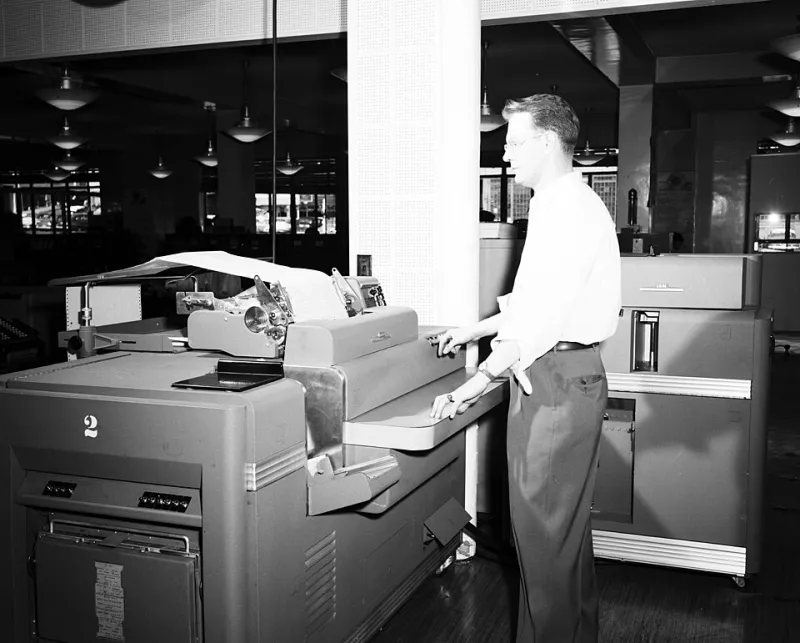
Photo: Seattle Municipal Archives, CC BY 2.0, via Wikimedia Commons
There is a particular genre of workplace software demo that ought to make anyone pause. A manager clicks through a dashboard and sees, laid out in tidy color-coded bars, exactly how an employee spent their Tuesday: forty-one minutes on a news site, six minutes in a messaging app, a productivity score of 71, trending down. Somewhere in that dashboard is a human being who agreed to a terms-of-service document they did not read, in an office that may never have told them the software existed.
The employee-monitoring industry has quietly become one of the growth stories of the remote-work era. Global Workplace Analytics and other researchers have documented a broad expansion of monitoring software deployments since 2020, and vendors with names that sound like defense contractors — ActivTrak, Teramind, Hubstaff, and dozens of competitors — now market keystroke logging, periodic screenshot capture, application tracking, and even algorithmic "sentiment" analysis of employee communications as standard features. This is not fringe surveillance. It is a product category with a sales deck.
What the Software Actually Records
The capabilities vary, but the high-end products are more thorough than most workers imagine. Keystroke loggers record not just volume but content, in some configurations. Screenshot tools can capture the screen every few seconds or at random intervals, building a visual diary of the workday. Application and website trackers log every window opened and every URL visited, often with categorization into "productive" and "unproductive" buckets determined by an employer's settings. Some platforms aggregate communication patterns and generate risk scores, flagging employees whose behavior deviates from a baseline.
The framing is always neutral — visibility, insights, productivity intelligence. But strip away the dashboard aesthetics and the underlying activity is surveillance in the plain meaning of the word: the systematic collection of a person's behavior without their meaningful awareness.
What the Law Actually Permits
Here is where American readers should feel a certain discomfort. In the United States, workplace monitoring is governed by a patchwork that leans heavily in employers' favor. The Electronic Communications Privacy Act permits monitoring of communications on company-owned systems, with limited exceptions. Courts have generally sided with employers on company devices and networks. The National Labor Relations Board has recently pushed back — its 2023 Stericycle decision established that broadly written workplace surveillance policies can unlawfully chill employees' right to organize — but that protection applies to concerted activity, not to the everyday experience of being watched.
A few states have begun to close the gap. New York, Connecticut, Delaware, and California require some form of notice of electronic monitoring, and New York's law, effective in 2022, obligates employers to provide written notice upon hiring. But notice is a low bar. A paragraph buried in an onboarding packet satisfies it. No American state requires consent in any meaningful sense, and none restricts the type of monitoring so long as it does not cross into clearly protected territory.
Contrast this with Europe, where the GDPR and national labor codes treat employee monitoring as a proportionality question: the surveillance must be necessary, and the least intrusive means must be used. The American worker enjoys no such assumption.
The Case Against the Dashboard
The standard defense is that employers have a legitimate interest in knowing what happens on equipment they pay for. Fair enough — nobody argues a company should be blind to its own systems. But the monitoring industry has long since outrun that rationale. Keystroke-level tracking of knowledge workers produces data of dubious value; a software developer's most productive hour may involve reading, thinking, and typing almost nothing. Productivity scores built on application usage are proxies at best, and proxies get gamed, which means the software doesn't just measure behavior — it reshapes it, pushing workers toward visible activity over actual output.
There is also the trust argument, which the industry treats as sentimental and which is, in fact, economic. Research on workplace monitoring consistently links perceived surveillance to higher stress and lower morale. Companies that monitor heavily are, in effect, purchasing short-term visibility at the price of long-term retention. In a labor market where skilled workers have options, that is a bad trade.
Assessing Your Own Exposure
Workers who want to understand their situation can do so without violating any policy. Read the acceptable-use and monitoring policies your employer is legally required to provide in several states — they typically specify what is collected. Check whether your work machine is company-owned or personal; personal devices generally receive stronger protection, and some states, including California, restrict employer monitoring of personal devices even on company networks. Assume, as a working rule, that anything typed or viewed on a company machine is potentially recorded — because it may well be. And note that privacy tools, workarounds, or attempts to evade monitoring can themselves violate policy; the goal is awareness, not evasion.
A Watched Desk Is Still a Desk
The opinion worth stating plainly is this: the normalization of workplace surveillance is a choice, not a technological inevitability, and it is a choice Americans have made by default rather than by debate. Other democracies have decided that the employer's interest in visibility must yield to proportionality. Congress and state legislatures could require the same — meaningful notice, data minimization, a prohibition on covert monitoring, and limits on algorithmic scoring of human beings.
Until then, the keyboard keeps its confession, and the dashboard keeps its score. The least workers deserve is to know they are being watched. The most they should ask is why anyone thought it was normal.